Hair Salon Chain Phone Handling: A Multi-Location Guide
How a group of hair salons can answer calls at every branch: routing, booking requests, late changes, no-shows and handover between locations.
A single hair salon can get by with a phone on the front desk. Two, five or twelve locations cannot. Stylists have their hands full of colour and clippers, receptionists are also running the till, and a ringing phone loses to the client in front of them every time. Multiply that by several branches and the missed calls add up to empty chairs.
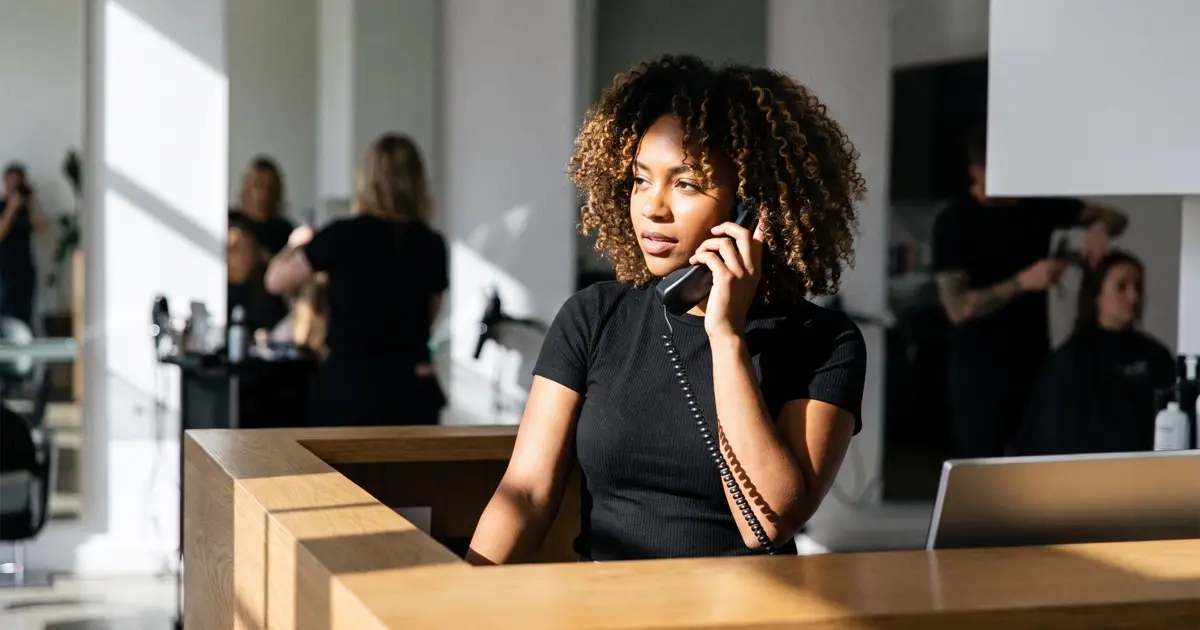
This guide is for owners and operations managers of multi-location salons who want a phone setup that works the same way across the group without making each branch sound like a call centre. If you are comparing approaches in general, start with What Is AI Phone Reception? and Phone Handling for Beauty Salons, then come back for the multi-branch details.
Why multi-location salons struggle with the phone
The problems are predictable. Calls arrive in bursts: just before opening, at lunchtime, and in the early evening when people finish work and think about their hair. Those are also the busiest times in the salon. A call that rings out is rarely retried; the caller moves on to the next salon in the search results.
A group adds its own complications. Clients call the wrong branch, or call the head office number printed on a flyer when they want a specific stylist. Each branch has different opening hours, different services and sometimes different price lists. Staff at one branch cannot see another branch's diary, so a simple "can you fit me in at your other salon?" becomes a callback.
Where calls go missing
- Peak hoursPhones ring while every receptionist is with a client at the desk.
- Wrong branchCallers dial the branch they used once, not the one nearest to them now.
- Stylist-specific requestsThe caller wants a named colourist who works at two locations on different days.
- Day-off and holiday gapsNobody answers a closed branch, and the voicemail is checked days later.
The calls a salon group actually receives
Before changing anything, listen to a week of calls or read your call log. Most salon calls fall into a handful of types, and each deserves a different treatment.
| Call type | Typical need | Best handled by |
|---|---|---|
| Opening hours, address, parking | A fact that rarely changes | Automated answer |
| Prices and service lengths | A list the caller could read online | Automated answer, with a link to follow up |
| New booking | Date, stylist and service | Booking request, then staff confirm |
| Change or cancellation | A specific appointment | Branch staff or a central desk |
| Running late | Urgent, time-sensitive | Fast route to the branch |
| Product or order question | Stock at a branch | Branch staff |
| Complaint or redo request | Needs care and authority | Manager, same day |
The first two rows are often a large share of all calls. Taking them away from the front desk frees receptionists for the conversations that need judgement.
Spotting the urgent ones
A client running ten minutes late and a client cancelling the next morning both have a deadline. Give those callers an obvious option in the phone menu, and make sure it rings somewhere that is actually staffed during opening hours. Our guide to designing the IVR way out explains why a clear route to a person matters.
Central desk or branch-by-branch?
The biggest design decision for a group is who answers. There is no universal answer; it depends on how much your branches share.
Two ways to organise answering
| Each branch answers its own line | Central desk with branch routing | |
|---|---|---|
| Local knowledge | Staff know the diary, the stylists and the regulars | Agents rely on a shared diary and notes |
| Resilience at peak | A busy branch simply misses calls | Overflow can move to another desk or to an AI agent |
| Consistency | Greeting and policy drift between branches | One greeting, one set of rules |
| Staffing | Every branch needs a person near the phone | Fewer people handle more calls, but need good tools |
| Best for | A few branches with strong local identities | Many branches with similar services |
Many groups settle on a mix. The branch answers first; if nobody picks up in a set time, or the branch is closed, the call overflows to a shared team or to an AI voice agent that can take a message or a booking request. The pattern is explained in AI Receptionist Overflow.
Designing the phone menu for several branches
A group number with a long menu ("press 1 for Mayfield, 2 for Riverside...") feels slow. Better options are to give each branch its own number, or to ask the caller for their location in a natural question. Keep the first menu short and put the most common intent first.
A simple multi-branch flow
- GreetingName the group in one short sentence.
- Which branch?Ask by name or by key; offer the nearest if the caller is unsure.
- What do you need?Book, change, or ask a question. Urgent change gets its own option.
- Open now?If the branch is open, ring its team. If not, give opening hours.
- No answerAfter a short time, offer a booking request or a callback instead of silence.
Hours matter more than they seem. Branches rarely share the same hours, and one late night a week is enough to confuse callers. Set each branch's hours and holidays once, and let the system decide where the call goes. Routing Calls by Business Hours, Holidays and Closures covers the details.
Where an AI voice agent helps, and where it should stop
A voice agent is designed to handle the repetitive part of the phone: greeting callers, answering questions about hours, services and directions from your own information, and taking down what a caller wants. For a salon, the useful job is to capture a booking request: name, preferred stylist, service, and a few possible times. The agent passes it to staff, who check the diary and confirm.
It should not confirm a booking on its own, quote a price that is not in your information, or decide how to handle a complaint. Hand those to a person. Callers can usually tell when they are talking to software, so say so; see Disclosing AI on Calls.
Making handover easy for staff
The most frustrating call for a client is the one where they explain everything twice. Whoever picks up after the agent, or after another branch, should see a short summary: who called, what they want, and what has already been said. AI Call Summaries describes how summaries save time after every call.
- Attach the caller's name and number to a contact record so the stylist sees past visits.
- Note stylist preferences and patch-test dates where your policy requires them.
- Keep a shared inbox of booking requests that the next free receptionist works through in order.
- Record who promised a callback, and by when.
Reducing no-shows and late changes
An empty chair is the most expensive outcome in a salon. Phones help in two ways. First, make cancelling easy: a client who cannot reach you will not cancel, they will simply not come. Second, send reminders. Many salons use a message or call the day before; check the rules that apply to your messages and consent, and see Reminder Calls for the options.
Offer a simple way to cancel or move an appointment out of hours, and review the cancellations at the end of each week. A pattern, such as Saturday morning slots being cancelled more than others, tells you where to change policy.
Measuring each location
Group averages hide problems. Report answer rate and missed calls per branch, per hour of the day. A branch that misses calls at the same time every weekday needs an overflow rule, not a new receptionist. Terms such as answer rate and abandon rate are explained in Answer Rate and Abandon Rate.
Weekly review for a salon group
- Calls answered by branch and by hour
- Calls that went to voicemail or a callback request
- Booking requests still waiting for confirmation
- Cancellations received outside opening hours
- Questions the agent could not answer, to add to the knowledge list
A rollout plan for several branches
- Pick one branch with a clear problem, such as missed calls at lunchtime, and start there.
- List its opening hours, services and answers to the common questions.
- Run test calls from staff phones, including tricky ones such as a client who is late.
- Switch on overflow only, so the branch still answers first.
- Review a week of calls, fix the wording, then add the next branch.
Doing it in Call
In Call, each branch can have its own queue with its own business hours and voicemail, so a caller to Riverside reaches Riverside's team while it is open and leaves a message when it is not. An IVR option can offer callbacks, and the callback list shows who still needs a return call. An AI agent can be set up with your answers and handoff rules, and call summaries and a shared inbox help the next person pick up where the last stopped. Contacts keep the client's details in one place. See Setting Up Call Queues and Setting Up IVR and Business Hours in Call for the steps.
Frequently asked questions
Should each salon branch have its own phone number?
Often yes, because callers search for the nearest branch. You can still route all numbers into one system so hours, greetings and reports are managed together.
Can an AI agent book hair appointments?
It can take a booking request with the service, stylist and preferred times. A member of staff should check the diary and confirm, so double bookings do not slip in.
What happens when the branch is closed?
Play the opening hours, then offer voicemail, a callback request or a message. Never leave callers in silence or a loop.
How do we handle callers who want a specific stylist?
Capture the stylist's name in the request and route it to the branch where they work. A shared inbox helps if the stylist moves between locations.
Do we need to tell callers the call is recorded?
Many places require notice or consent for recording. Rules differ by country and region, so check official guidance and say so clearly at the start of the call.
How do we know whether it is working?
Compare answer rate and missed calls per branch before and after the change, and read a sample of call summaries each week.