 IVR explained
What is IVR? How an IVR phone system works
What is IVR? How an IVR phone system works step by step: menus, keypad and speech input, routing, voicemail and callbacks, and how to choose IVR software.
Ideas for designing and running phone support, and how to do it with Call.
IVR explained
What is IVR? How an IVR phone system works step by step: menus, keypad and speech input, routing, voicemail and callbacks, and how to choose IVR software.
 Compare
IVR vs AI voice agent: how traditional IVR systems, voicebots and AI voice agents differ, what each does best, where each goes wrong and how to combine them.
 How-to
How to build an AI voice agent in 7 steps: define its job, add knowledge, write instructions and handoff rules, test, and go live small. Plus best practices.
 AI call summary
How AI call summaries work, where they cut after-call work, and how to check them before they become your record. Try CALL free.
 Compare
Human answering service or AI receptionist? Compare hours, quality, handoffs, records and cost, and see when to use both.
How to decide who can see and do what in a contact center: roles, least privilege, joiners and leavers, recordings, sign-in protections and regular reviews.
What after-call work is, how to measure it fairly, why it grows, and practical ways to shorten wrap-up without losing the notes that matter.
Warning signs of agent burnout, its common causes in call work, and practical steps to reduce it through scheduling, workload, recovery time and support.
A week-by-week plan to bring new support agents up to speed: preparation, shadowing, supported calls, feedback and a 30-day review, with a team lead checklist.
How to review phone agents fairly: choose measures they can influence, use samples of real calls, calibrate reviewers and turn results into coaching.
How cafes and bakeries can handle calls during the rush: pre-orders, opening hours, allergen questions, catering requests and when to hand off to a person.
How bank and credit union branches can handle appointment requests, urgent card and fraud calls and identity limits by phone, and what to keep from automation.
How a car dealership can route sales, service and parts calls, capture test-drive and trade-in requests, and follow up fast, with or without an AI receptionist.
How car rental branches can handle booking requests, pick-up and return questions and urgent roadside calls without slowing the counter.
How caterers can collect complete event enquiries, handle dietary and allergy information safely and keep a clear line for urgent day-of-event calls.
How churches, temples, community halls and similar organisations can handle practical enquiries, pastoral calls and volunteer-run phones with care.
How a cleaning company can handle quote requests, recurring bookings, cancellations and complaints by phone, and where an AI receptionist can safely help.
How coworking spaces can handle tour enquiries, urgent member issues and visitor calls by phone while community managers stay focused on members.
How electrical contractors can sort urgent faults from routine jobs by phone, capture the right details and use an AI receptionist without adding safety risk.
How a group of hair salons can answer calls at every branch: routing, booking requests, late changes, no-shows and handover between locations.
How heating and cooling contractors can handle breakdown calls, seasonal surges, maintenance plans and safety concerns by phone, and where automation helps.
How language schools can answer enquiry calls, sort callers by level and goal, handle enrolment peaks and support current students by phone.
How a locksmith business can handle lockout calls, check who is entitled to entry, give honest expectations on cost and arrival, and use automation safely.
How delivery and logistics companies can handle parcel status calls, failed deliveries, claims and driver lines without overloading the phone.
How a moving company can handle quote requests, date changes and moving-day calls: what to capture, who calls back and where an AI receptionist helps.
How nonprofits and charities can handle calls from donors, volunteers and people seeking help, with safe routes for crisis calls and clear limits on automation.
How an optician's practice can handle eye-test bookings, glasses-ready and repair calls and urgent eye concerns, with clear routing and sensible automation.
How a physiotherapy clinic can handle new-patient enquiries, course bookings, cancellations and referrals by phone while protecting privacy.
How self-storage facilities can answer enquiries, handle gate and access problems, manage account calls and cover out-of-hours phones.
How spas and wellness centres can handle bookings, treatment questions and health details by phone, without interrupting therapists or the guest experience.
How mobile and internet retailers can separate sales from support, triage faults by phone and keep the shop floor moving while calls are covered.
How travel agencies can separate planning enquiries from urgent traveller calls, protect consultant time and handle disruption peaks by phone.
How university and college admissions offices can handle applicant calls, deadline peaks, results days and out-of-hours enquiries without overpromising.
How utility customer service teams can put emergencies first, cope with outage surges, support customers in difficulty and use automation carefully.
How an emergency animal hospital can handle urgent calls: what to ask, what never to say, handover to a clinician and cover for nights and busy hours.
How an AI receptionist can collect appointment requests without overpromising: what to ask, how to avoid double bookings, and when a person confirms.
How to be honest about automation, avoid frustrating callers, protect their data and give an easy route to a person, so an AI receptionist strengthens trust.
A catalogue of twenty calls small businesses get again and again, with advice on which an AI receptionist can handle and which need a person.
A way to weigh the cost of an AI receptionist against missed calls, staff time and alternatives, without relying on headline prices that may not apply to you.
How to design an AI phone receptionist that older callers can use comfortably: pace, wording, patience, repetition and an easy route to a person.
How to choose, word and organise the questions and answers an AI receptionist uses, so callers get short, correct replies and unknowns are handled well.
How a freelancer, tradesperson or consultant can use an AI receptionist to stop missing calls while working, and where a human still needs to step in.
How to use an AI receptionist to cover predictable gaps such as lunch breaks, school runs and rush periods, with clear rules for what it handles and what waits.
Which numbers and reviews tell you whether an AI receptionist is helping, from missed calls and message quality to callbacks and caller feedback.
What a good phone message contains, how an AI receptionist can capture names, numbers and reasons reliably, and how to check and act on them quickly.
Seven common beliefs about AI receptionists, from robotic voices to made-up answers, checked against how the technology really works and how to test it.
How to let people answer first and bring in an AI receptionist only when lines are busy or nobody picks up, and how to keep the callers' experience smooth.
A practical plan for the first seven days of an AI receptionist: what to prepare, test and review each day, and when to widen or pause.
How to introduce an AI receptionist to a team in a way that earns trust: address worries, share the plan, involve staff in testing and agree who does what.
How to choose the voice, greeting, wording and pace of an AI receptionist so it sounds like your business: warm, clear and appropriate for your callers.
What an audit log is, what a contact center should record in one, how to read it, how long to keep it and how it supports security, quality and trust.
How Australia's Do Not Call Register works: which calls it covers, consent, washing call lists, calling hours, caller identification and record keeping.
How to write automatic replies for email, chat and messages that help rather than irritate: what to say, what to avoid and when to stay silent.
What average speed of answer (ASA) measures, how it differs from service level and longest wait, how to calculate it and how to improve it.
How to run calibration sessions so reviewers score calls the same way: choose calls, score blind, discuss gaps, refine the scorecard and track agreement.
What each agent status means in Call, how people and supervisors change it, how the idle break works, and habits that keep queues and breaks fair.
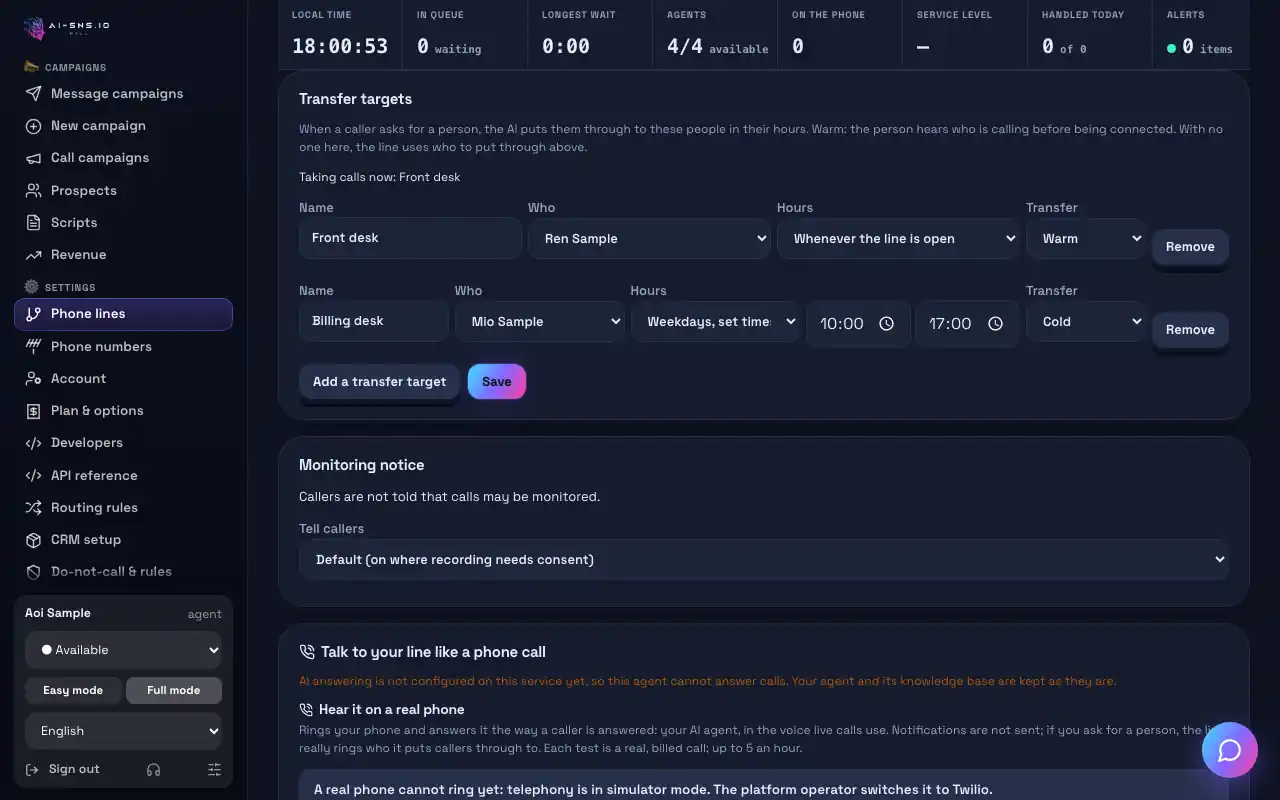
How to design a clean hand-over from an AI phone agent to your team: when to hand over, who rings, warm or cold transfer, out-of-hours fallbacks and follow-up.
How to pick an AI voice that suits your callers, compare samples, tune speed and pronunciation, give a line its own voice and test it before customers hear it.
A tour of the analytics in Call: Home tiles, Reports tabs, the wallboard, admin analytics and voice analytics, and the question each screen answers.
How to run a diary of bookings and call-backs, offer an online booking page, confirm pending requests and keep no-shows low with a simple weekly routine.
How to stop nuisance callers reaching your lines in Call: block a number or range, choose what they hear and review turned-away calls to protect real customers.
How confirm, cancel and move links in reminders let customers handle their own appointments, what rules to set, and how to keep the diary accurate afterwards.
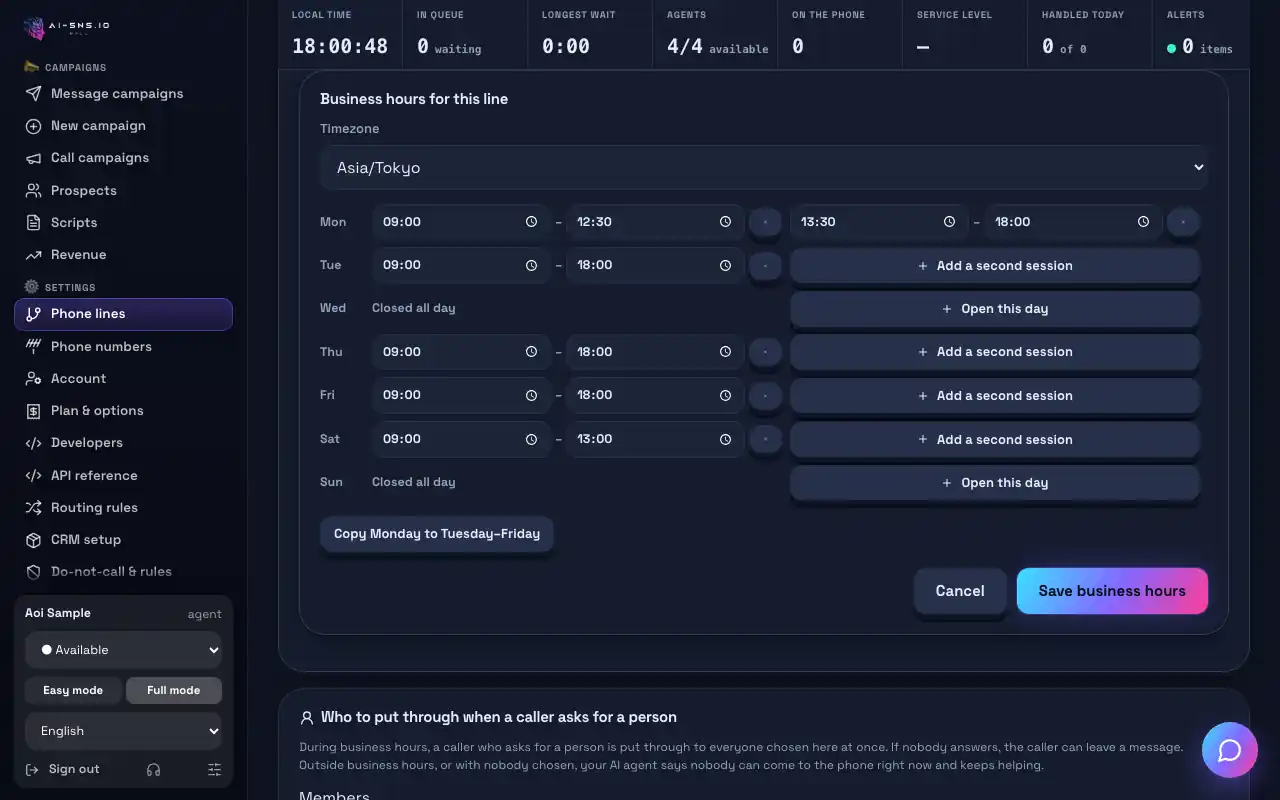
How to set opening hours, lunch breaks and public holidays, and prepare for an emergency closure, so callers always hear the right thing.
How to write a call script that helps rather than constrains, attach it to a phone line, campaign or batch in Call, and learn which wording works.
How a callback request travels through Call: where waiting call-backs appear, how to take one, record the result and stop promises from slipping.
How calling-hours checks work in Call, why a call is refused or held, how local time and country rules apply, and what to do when a batch has numbers waiting.
A repeatable coaching framework for team leads: choose calls, set one focus, run a short session, agree one action and check whether later calls improve.
Set up contacts, companies and custom fields in Call, import a list, work a contact page with notes and tasks, and keep records clean for phone teams.
Why duplicate contacts appear in a phone-team CRM, how to tell a true duplicate from a lookalike, and how to merge two records without losing calls or notes.
What a private customer portal link shows, how to create, replace and withdraw it, which changes to let customers make themselves, and how to handle their requests.
A practical tour of the Call REST API: API keys and scopes, rate limits, error handling, signed webhooks and the Developers page where you manage endpoints.
Plan, build and run an outbound calling campaign in Call: the list, the script, dialling modes, retries, machine detection and the checks every call passes.
How to keep a suppression list in Call: add and import numbers, check one before dialling, see what the rules refused, and remove a number only when asked.
What Easy mode shows and hides, when a small team should use it, how to switch between Easy and Full mode, and how to grow into the full console at your own pace.
How to use the Call help centre: search the how-tos, browse by area, open the guide for the page you are on and read the steps, settings and troubleshooting.
A practical walk-through of taking an inbound call in Call: going on the phone, answering or declining, handling a second call, holds, and logging the outcome.
How to build a small library of reusable message templates for replies, reminders and campaigns, with merge fields, a consistent tone and a review habit.
How Call works in a phone browser: the menu rail, setting your status, taking calls, ringing your own mobile and which jobs are easier on a laptop.
A practical guide to the first and last thirty seconds of a support call: greeting, verification, direction, summary, next steps and a warm, clear close.
How simulated practice calls let you test an AI phone agent on hard cases first, how to read the grades and lessons, and how to turn findings into fixes.
Design a fair quality scorecard for phone calls, then use Call to score, coach and calibrate: weights, critical items, automatic scoring and review queues.
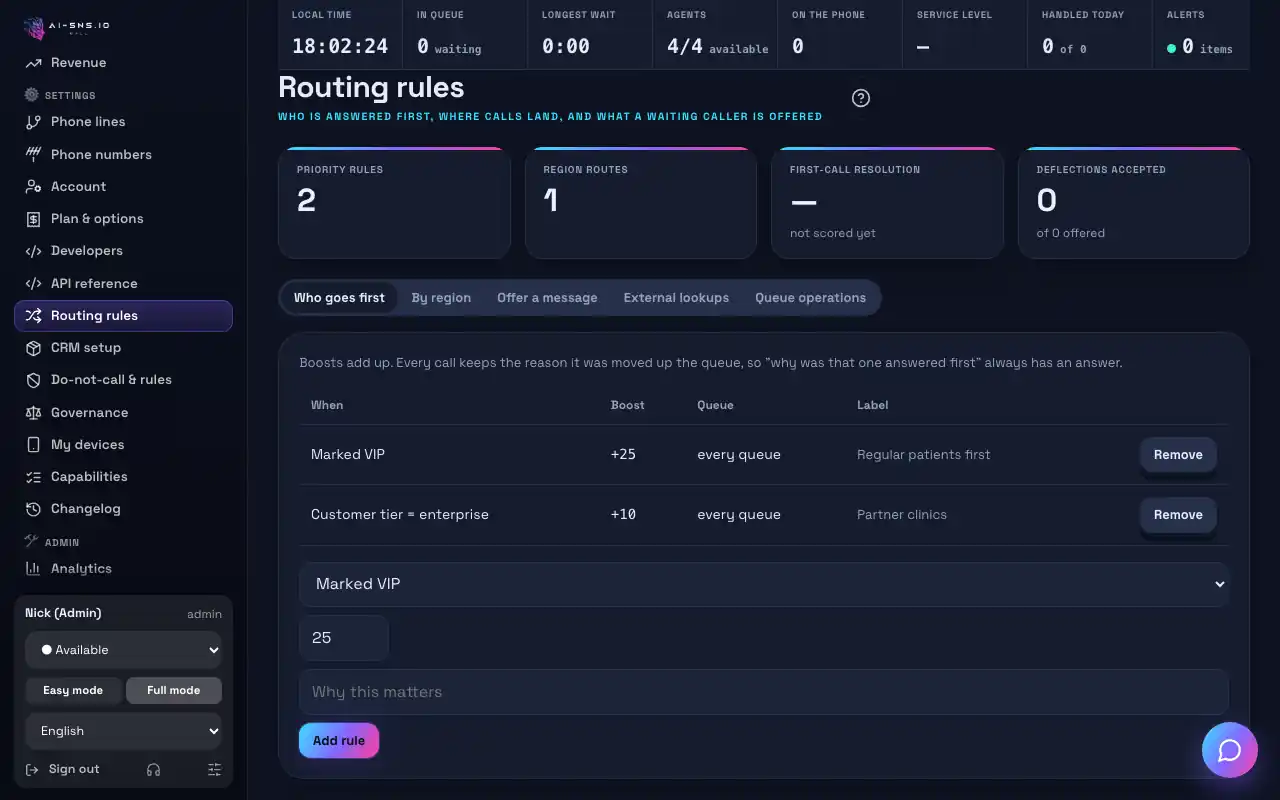
How to set up call queues in Call: who is offered calls by skill, how long phones ring, what happens on overflow, who goes first and which alerts to set.
How call recording works in Call: who can play a recording, what controls which calls are recorded, and how long to keep them.
How one-party and two-party (all-party) consent rules differ for recording calls, why cross-border calls are tricky, and a simple policy that works everywhere.
How to read the Reports screens in Call, build your own report, export it to CSV, save and email it on a schedule, and export call history for deeper analysis.
What each role in a call-centre system should be able to do, how Call maps agents, managers, admins and owners, and how to give people only the access they need.
When showing your screen to a caller beats explaining, how to do it step by step, what to protect before you share, and how to end the share cleanly.
How to draw a call script as steps and branches in Call, plan answers, check before saving, restore old versions and keep every place that uses it in step.
How a shared inbox keeps every customer message and phone inquiry in one list, with views, ownership, saved replies and a simple routine so nothing is missed.
What the stop-all switch in Call does and does not stop, who can press it, how the automatic stop works, and how to restart calling safely afterwards.
How to write a prompt that turns a call transcript into a short, accurate note: who it is for, what to include, rules against invention and how to test it.
How supervisors in Call can listen to a live call, read the live transcript, step in on an AI-handled call, and what the tools do and do not do.
How to search every call transcript for a phrase, competitor or promise in Call, read the result in context, and turn what you find into coaching and fixes.
Why a password alone is not enough, how two-factor sign-in works with an authenticator app, how to set it up, store recovery codes and handle lost phones.
How to plan voicemail for each call queue: when callers reach it, what the greeting says, who follows up and how to turn messages into call-backs in Call.
How to turn website visitors into leads with a form, a short demo and a prompt call-back, what consent to collect, and how to review and follow up every lead.
Plan who is on the phones with Call: shift shapes, the rota, availability preferences, swaps and overtime, adherence checks and how to handle time off fairly.
How Call tells you a new version is live, what the update bar does, how to read What's new, and a simple routine for sharing changes with your team.
What a workspace is, when someone belongs to more than one, how to switch safely in Call, and habits that stop you changing the wrong organisation by mistake.
How to define and measure callback completion rate, what the number reveals about your queue, and the habits that keep promised callbacks on time.
Why caller ID should show a real, callable number, how spoofing rules and number reputation work in general terms, and a checklist for honest outbound calls.
How Canada's National DNCL works: who must register, what the CRTC rules require, exemptions, internal lists, consent, calling hours and record keeping.
How to offer customers a choice of channel without overloading your team: how to find out their preference, record it, respect it and keep replies consistent.
Plan a contact center budget from drivers, not guesses: call volume, staffing, tools, training and contingency, in a simple model you can update each quarter.
A people-first plan for rolling out a new phone system: stakeholders, communication, training, a phased launch, go-live support and early feedback.
Prepare phone support for outages, closures and emergencies: risks, backup routes, caller messages, communication, drills and post-incident review.
Write support documentation agents open during a live call: short pages, clear owners, simple structure, easy search and a routine that keeps it current.
Design escalation paths for phone support: when to escalate, who takes it, what to hand over, how to keep the caller informed and how to review the paths.
A practical plan for startups that need phone support: what to set up first, how to stay small, which numbers to watch and when to add queues or AI.
A plain-English glossary of contact centre terms, grouped by routing, metrics, quality, workforce, voice AI and compliance, so new team members can follow along.
Manage a phone support team split between office and home: fair scheduling, equipment, call quality, coaching, culture and tools that keep everyone in sync.
A calm plan for moving phone support to a cloud contact center: audit, design, pilot, number cut-over, training and a rollback route for the first weeks.
Run phone support across several offices or regions: shared standards, routing between sites, time zones, staffing, reporting and one voice for callers.
Compare outsourcing and in-house phone support on control, knowledge, flexibility, quality and cost, with a decision method and a hybrid option.
Plan for holiday rushes, launches and annual deadlines: forecast demand, staff flexibly, trim avoidable calls, protect urgent ones and learn from each peak.
Design phone and web self-service callers use willingly: pick the right topics, keep a way to a person, write clear steps and measure whether it helps.
How to design service levels for phone support: choose measures, set targets you can meet, write them as promises, report honestly and review them over time.
Too many support tools slow agents and hide customer history. Audit your stack, decide what to merge or retire and migrate without disrupting the team.
A practical list of questions to put to any contact center software vendor, from telephony and routing to reporting, data, support and exit terms.
Why a single customer history across calls, messages and email matters, what to include in it, how to keep it accurate and respect privacy rules.
How to record call outcomes, notes and follow-ups quickly and consistently: what to capture, what to automate, and how to keep wrap-up time short.
What belongs on a single customer view for a phone team: identity, history, open items and cautions, how to keep it accurate, and what to leave off the screen.
A practical routine for accurate CRM contact data: prevent bad entries, find and merge duplicates, standardise phone numbers and retire stale records safely.
What to look for in a CRM when your team works by phone: fast call context, simple logging, clear ownership, follow-up reminders and a view managers can trust.
How to import a contact list into a CRM safely: prepare the file, map columns, handle phone formats and duplicates, test a small batch and check skips.
How to decide who gets each new lead: simple assignment rules, ownership, speed targets, rebalancing and the checks that stop leads from being left uncalled.
How to design a short, clear pipeline for phone sales: define each stage by what has happened, set exit rules, track stale deals and learn from lost ones.
How to follow up a quote by phone: what to send, when to call, what to say, how to record the answer and when to let a quote go, with a simple cadence.
Which reports a phone sales team really needs: activity, outcomes, speed to first call, pipeline health and loss reasons, and how to read them honestly.
How to use tags and rule-based segments to build call lists that make sense: naming rules, when to tag, how segments differ and how to keep both tidy.
What customer effort score (CES) tells you about phone support, how to ask the question, how to read the answers and what to fix first.
How to apply data minimisation to support calls, forms and records: ask only what you need, avoid sensitive details and shorten how long you keep data.
Practical de-escalation for support agents: staying calm, letting callers vent, acknowledging, setting boundaries, offering choices and when to hand over.
How to choose the right address, set up a shared mailbox, organise ownership and replies, and avoid common mistakes with SPF, DKIM and no-reply addresses.
Practical habits for email customer support: subject lines, first replies, structure, tone, templates, escalation and when to pick up the phone instead.
How agents can sound genuinely caring on the phone: listening, naming feelings, using plain phrases, avoiding stock lines and balancing empathy with real help.
What Erlang C is, what it assumes, what inputs it needs and how to read the result, with a worked example and the limits to keep in mind.
What the EU AI Act's transparency duties mean for voice agents that answer or place calls, with a checklist for telling callers they are speaking to AI.
A step-by-step way to forecast calls by day and half-hour from your own history, adjust for events and trends, and turn the forecast into a staffing plan.
What the GDPR means for recording customer calls: lawful basis, telling callers, retention, access, security, pausing for payments and a working checklist.
How to handle requests to see or erase personal data held in call recordings, transcripts and logs: verification, searching, timing, exceptions and records.
A plain-English overview of how HIPAA affects phone calls in US healthcare: protected health information, identity checks, voicemail and vendors.
How to place a caller on hold and transfer a call politely: asking permission, explaining why, warm versus cold handovers, avoiding lost calls and what to say.
How to make phone menus usable for callers with hearing, speech, cognitive or mobility needs: timing, wording, alternatives, relay services and testing.
How to prepare phone-menu messages for outages, closures and urgent incidents: what to say, who approves it, how to switch it on fast and how to lift it.
How to offer language choices in a phone menu: when to ask, how to word the options, which languages to offer first, and what to do when a caller needs help.
How to design phone menus for organisations with many departments: grouping, directories, skills-based routing, ownership rules and avoiding deep menu trees.
How to write queue announcements that keep callers on the line: position updates, wait estimates, callback offers, hold music and message frequency.
How to plan phone-menu changes for holidays, peak seasons and campaigns: a calendar, message templates, approval steps, testing and cleaning up afterwards.
Compare voice-driven and key-press phone menus on accuracy, accessibility, noise, cost of change and caller experience, and learn when to combine both.
A practical checklist for testing an IVR before launch: paths, prompts, hours and holidays, errors, load, devices, accessibility and how to sign off.
How to draw an IVR call flow first: symbols, a step-by-step method, handling dead ends and errors, and checking the map with real callers before you build.
Why every phone menu needs a clear route to a human, where to put it, what to say while callers wait, and how to keep that route working outside business hours.
How to spot the answers your team and AI agents are missing by reviewing calls, grouping repeated questions, and closing each gap with a clear, owned answer.
A small phone team does not need thirty metrics. Learn which five to put on one dashboard, how to read them together and how often to review them.
How to set call centre KPI targets that people can actually reach: start from your baseline, link targets to goals, avoid gaming and review them often.
How quickly should you answer a message compared with a call? Learn to set realistic targets for each channel, measure them and communicate them to customers.
How to set a consistent voice for chat, email and message replies: warmth, clarity, length, apologies, and a one-page tone guide your whole team can follow.
Why a quick message after a missed call can save a customer, how to write it, which rules apply, and when a call-back is the better choice.
How Net Promoter Score works, how to use it after support calls, its strengths and weaknesses, survey design tips and how to turn scores into action.
How agent occupancy and utilization differ, how each is calculated, what ranges to watch for, why very high values hurt, and how to use them to plan fairly.
How to book appointments by phone: preparing the call, offering clear options, confirming details, reducing no-shows and recording every booking.
How to choose the right time for outbound calls: local time rules, daily and weekly patterns, testing your own data, and respecting people's time.
How to plan an outbound call cadence: how many attempts, how far apart, which channels to mix and when to stop, without turning persistence into pressure.
How to make payment reminder calls that recover what is owed without harassing anyone: tone, timing, what never to say, and recording every outcome.
How to write a follow-up email after a sales or service call: timing, subject lines, structure, what to include, and how to respect opt-out rules.
A practical guide to phone lead qualification: what to find out, which questions to ask, how to score fit and timing, and how to pass leads on well.
How to keep an outbound calling list accurate and lawful: sourcing, validation, de-duplication, do-not-call checks, retirement rules and regular reviews.
How the number you display affects whether people pick up: local presence, branded caller ID, spam labels, honesty rules and how to protect your reputation.
Which outbound calling metrics tell you something useful, how to define them, how to avoid vanity numbers and how to review them with your team.
A practical approach to objections on outbound sales calls: listen, understand the real concern, answer honestly and know when to accept a no.
How to plan renewal and retention calls that respect the customer: who to call, when, what to say, how to handle a no, and how to record the outcome.
How to run phone surveys that people actually finish: choosing who to call, writing short questions, handling refusals and turning answers into action.
A practical coaching routine for outbound teams: what to listen for, how to give feedback, how often to meet and how to check that coaching works.
How to write and deliver outbound voicemails that people return: what to say, how long to speak, when to skip, and how to handle recorded messages fairly.
Warm and cold outbound calls need different openings, expectations and rules. Learn how to tell them apart, prepare for each and measure them fairly.
How to take phone payments without card numbers passing through agents or recordings: the main options, a simple process and a rollout checklist.
How to decide how many calls to review for quality: random and targeted samples, per-agent minimums, small-team shortcuts and how to avoid bias in your sample.
Learn how to measure repeat call rate, separate healthy follow-ups from failures, and trace second calls back to causes you can fix at the source.
How the US, UK, EU, Canada, Australia and Japan treat automated and prerecorded calls in general terms, with the common themes and a pre-dial checklist.
What schedule adherence and conformance mean in a contact center, how to calculate them, how to use them fairly and the mistakes that turn them into a stick.
What call sentiment analysis measures, where it helps with triage and trends, where it misleads, and how to use it without unfair or automated decisions.
What the 80/20 service level means, how to calculate it, why it is a convention and not a law, where it misleads and how to pick a target that fits.
How to turn expected call volume into a fair, workable rota: the inputs you need, how to shape shifts, where breaks go and how to check the plan.
What a SIP trunk is, how it differs from traditional phone lines, what to check on codecs, channels and failover, and how to choose a provider.
How to monitor, triage and answer support requests that arrive as social direct messages, when to move a conversation elsewhere, and how to protect privacy.
Two ways to build a phone voice agent: speech-to-speech models and cascaded pipelines. What each does well, where each is weak and how to choose by testing.
Why narrowband, compressed and noisy phone audio trips up speech recognition, how to spot the symptoms and what you can fix in the setup and the script.
A practical approach to leave requests in a call centre: clear rules, a visible process, tie-breakers people accept and how to protect cover without resentment.
How to measure transfer rate, tell good transfers from bad ones, find the causes of bouncing calls and fix routing, training and handover habits.
When to use machine translation, when to bring in a human, how to write replies that translate well, and how to set up a workable multilingual support process.
How a voice agent decides when to speak, wait or stop, why overlap and pauses are hard, and how to design phone conversations that feel natural to callers.
Silent and abandoned calls explained: what Ofcom's persistent misuse policy expects of UK callers, how dialler settings cause them and how to reduce the risk.
How voice activity detection tells speech from silence on a call, why timing goes wrong, and how to tune the silence wait so an agent does not interrupt or lag.
Why voice agents understand some accents better than others, what you can adjust and how to build a fair test with real voices so no caller is shut out.
A practical way to judge a phone voice agent: the metrics worth tracking, how to sample and score calls, and how to turn findings into fixes.
How function calling works for phone voice agents: lookups versus actions, what makes a good tool, the risks of speech input and how to keep calls natural.
The layers of guardrails for a phone voice agent, from prompts and approved sources to enforced limits and handover rules, with a test script to run first.
Why voice agents sometimes state things that are not true, and the practical steps that limit it: grounded sources, safe fallbacks, trap questions and review.
Why a voice agent mishears digits, surnames and street names, and the read-back, chunking and fallback techniques that make capturing these details dependable.
How to build privacy into a phone voice agent from the start: map the data a call creates, give notice, collect less, mask sensitive numbers and set retention.
How to recognise and support customers who may be vulnerable on calls: signals, adjustments, careful questions, handoffs, record keeping and staff care.
When and how to move a web chat conversation to a phone call: the signals to look for, how to ask, what to pass on and how to record the outcome.
How a browser makes phone calls with WebRTC: permissions, signalling, firewalls, gateways to the phone network, quality factors and a troubleshooting checklist.
How to offer customer support on WhatsApp Business: when it suits you, how to set expectations, handle consent and hand over between chat and phone.
A plain guide to automatic call distribution: how calls reach the right agent, common routing methods, queue and skill design, and how to manage waiting time.
How to handle calls when you are closed: set hours and holidays, write a short announcement, capture messages and callbacks, and follow up the next morning.
How to reduce average handle time safely: split AHT into talk, hold and wrap-up, remove real delays, and track resolution and satisfaction alongside it.
Why telling callers an AI is on the line builds trust, what rules broadly say, where to place the disclosure, how to word it and how to offer a person.
How a workshop can handle calls while hands are busy: sort breakdowns from bookings, capture details, plan for seasonal peaks and keep quotes with staff.
How salons can keep the phone from competing with the chair: sort calls, collect booking details in a fixed order and leave confirmation and advice to staff.
A map of AI phone handling by sector: shared design principles, a cross-industry checklist and links to guides for clinics, shops, trades, services and more.
How a clinic can handle calls safely: sort urgent from routine, take appointment requests, protect health data and keep clinical judgment with clinicians.
How building and renovation firms can answer enquiries while on site: capture leads, arrange site visits, handle urgent repairs and leave quotes to people.
How tutoring centres can manage calls around classes and term peaks: handle enrolment enquiries and absences, protect children's data keep decisions with staff.
How dental practices can handle calls: sort bookings from emergencies, protect the diary with easy cancellations and leave clinical decisions to the team.
How online retailers can handle phone calls: cut avoidable order-status calls, route returns and complaints to people and keep card payments off the phone.
How organisers can plan phone handling for on-sale spikes and event days: publish answers early, route refunds to people and keep payments off the phone.
How gyms can handle calls when the front desk is busy: welcome prospects, answer member questions, process freezes fairly and cover unstaffed hours.
How funeral homes can sort calls with a phone menu, hours rules and an AI first response, while keeping every bereavement call with a person.
Ready-to-adapt greeting scripts for automated answering: after hours, busy lines, holidays, menus, voicemail and AI agents, plus the rules behind them.
How small hotels, inns and ryokan can sort reservation, in-stay and arrival calls with a phone menu, hours rules and an AI first response with staff handoff.
How independent insurance agencies can sort accident, renewal and quote calls with a phone menu and AI first response, and keep advice with licensed staff.
How judicial and administrative scrivener offices in Japan can sort registration, permit and inheritance calls with a phone menu and an AI first response.
How small law firms can use a phone menu and AI first response to take intake calls, protect confidentiality and hand callers to a lawyer without giving advice.
How municipal and local government offices can sort resident calls with a phone menu and AI first response, keeping decisions and emergencies with staff.
How nail and esthetic salons can answer calls during treatments with a phone menu and AI first response that takes booking requests without confirming them.
How home care and day care providers can sort calls from families, staff and referrers with a phone menu and AI first response, leaving care to people.
How pharmacies can sort refill, stock and medicine calls with a phone menu and AI first response, while keeping medicine advice with the pharmacist.
How plumbing, heating and repair businesses can triage emergency and routine calls with a phone menu and AI first response while engineers are on site.
How rental property managers can sort tenant, owner and contractor calls with a phone menu, hours rules and AI first response, including after-hours repairs.
How sales and lettings agencies can capture portal enquiries, viewing requests and owner calls with a phone menu and AI first response, with agents confirming.
Thirty straight answers to the questions businesses ask before using an AI to answer their phone: how it works, accuracy, privacy, handoff and getting started.
How staffing and recruiting agencies can sort candidate, temp and client calls, record details safely and keep interviews and pay in human hands.
How a restaurant can answer fixed questions automatically, record table requests for staff to confirm, and keep the phone from interrupting service.
How software and IT companies can triage phone calls by impact, gather context before an agent joins, and keep security and billing decisions with staff.
How accountancy and tax practices can answer routine calls, cope with deadline peaks and keep advice and confidential matters with qualified staff.
How taxi, private hire and shuttle operators can organise calls, keep dispatch decisions with people and cope with weather and event peaks.
How veterinary practices can put emergencies first, automate routine questions, capture complete messages and keep clinical judgement with staff.
How wedding venues can capture every enquiry warmly, keep availability and quotes with coordinators and stay reachable on busy weekends.
A practical look at the limits of an AI receptionist, the cases that should always reach a person and how to design hand-offs that never leave a caller stuck.
A step-by-step checklist for setting up an AI receptionist: audit your calls, define scope, write content, set hours, test and review after launch.
How to calculate answer rate and abandonment rate, which definitions change the result, how to read them with wait times, and what to do about abandoned calls.
What barge-in is, why interruption handling is hard on phone lines, and how to write replies, set options and test calls so a voice agent feels natural.
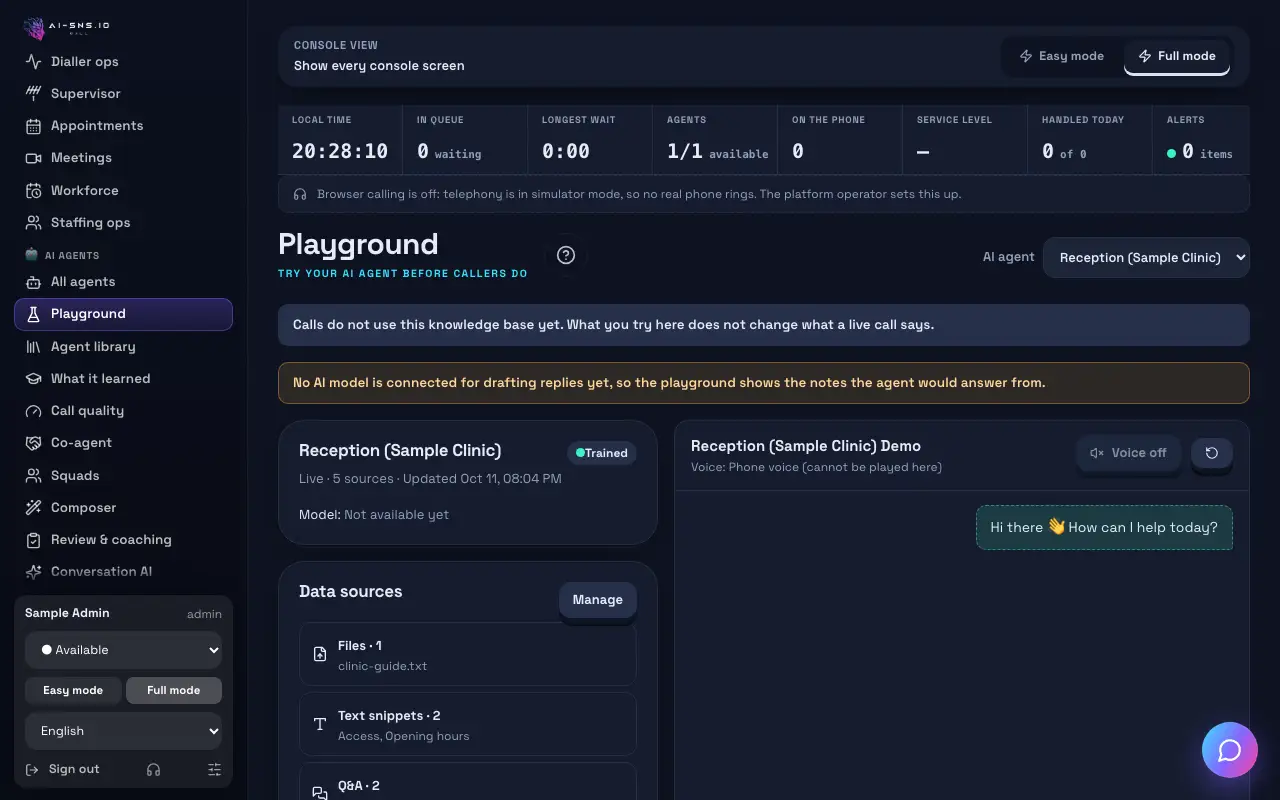
A step-by-step guide to creating an AI agent in Call: define its job, add knowledge, set tone and voice, test it and assign it to a phone line.
How to design a call analytics dashboard: start from decisions, pick measures for each audience, read hourly patterns and set a review rhythm.
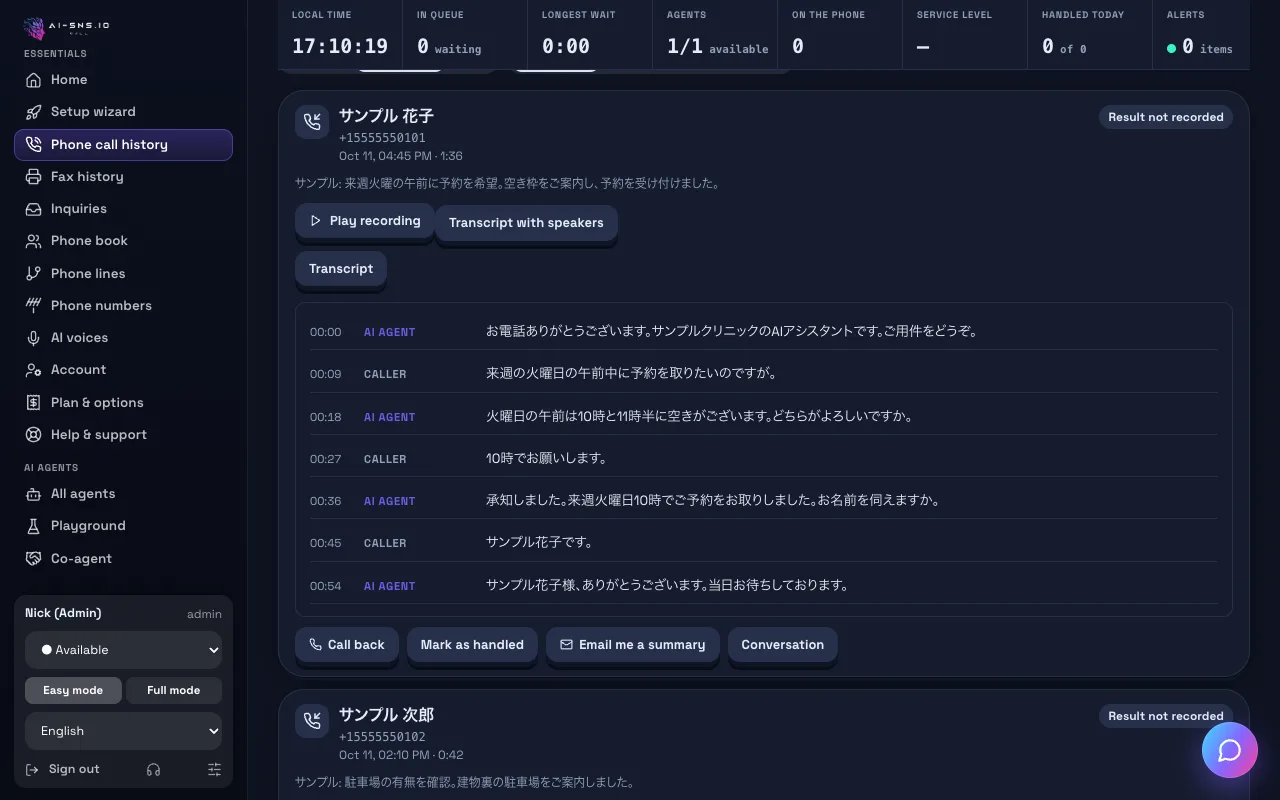
How to read call history, check AI summaries against transcripts, turn calls into callbacks and handovers, and keep call records private in Call.
A guide to contact-centre KPIs in five families: access, efficiency, quality, resolution and capacity, with definitions, pitfalls and how to choose.
A practical first-day guide to Call: create a workspace, learn the screens, set business hours and a first call flow, then test it before real callers arrive.
How to use Call's ticket list to follow up every caller who asked for a person or a call back: statuses, assignment, notes, callbacks and a daily routine.
Plan a phone menu and business hours before you click: menu design, hours and holidays, closed-hours behaviour, queues, testing and how to change it safely.
Learn which knowledge source to use for which content in Call, how to add files, website pages, text snippets and Q&A, and how to check what your agent finds.
How to tell callers a call may be recorded: when a notice is needed, sample wording for inbound, outbound and AI calls, and a practical rollout checklist.
How to take and make calls in your browser with Call: first-time setup, headset choices, answering, holding, internal calls and fixing audio problems.
Compare cloud and on-premise contact-center systems on cost shape, control, resilience, change speed and staffing, with a decision guide and migration outline.
A five-step plan to modernise a contact center: set goals, map the current state, choose a first slice, run a pilot and scale, without a big-bang rewrite.
Build a knowledge base that agents and AI assistants can use on calls: what to include, how to write answers, structure, ownership and review.
How to measure customer satisfaction after phone calls: choosing the question, when to ask, handling low response, reading scores fairly and acting on feedback.
Seven practical ways to improve the phone experience: shorter waits, a clear greeting, a way to a person, listening, honest handoffs, follow-up and learning.
How to handle abusive callers: define the line, give staff scripts, protect them during and after the call, record evidence and review your policy.
How to decide what call data to keep: recordings, transcripts and logs, retention periods, deletion, backups, access requests and a sample schedule.
What first call resolution means, how to measure it honestly, how it differs from handle time, and practical ways to raise it through knowledge and handoffs.
A plain-English tour of the pipeline behind voice AI phone agents: speech-to-text, a language model, text-to-speech, plus turn-taking, delay and safe handoffs.
Which IVR numbers matter, how to find the point where callers give up, and a simple routine for testing one change at a time and checking that it worked.
How to route calls differently by day and time, handle holidays and one-off closures, and decide what callers hear and can do when nobody is available.
When to offer a callback, when voicemail is enough, how to word the prompts, and how to make sure every message and callback request actually gets answered.
Ten problems that make callers hang up on phone menus, from long greetings to dead ends, with a practical fix for each and a checklist for a quick self-audit.
What a dial-by-name phone directory is, when it helps and when it frustrates callers, how to set one up, and how to keep names accurate.
How to design a phone menu callers can follow: how many options and levels to use, how to order and word them, and how to test the result before going live.
How to choose between a recorded human voice and text-to-speech for phone prompts, how to write for the ear, and how to keep audio clear and current.
A low-effort way for a small business to set up a phone menu: whether you need one, the smallest design that works, what to say and how to keep it fresh.
How businesses in Japan and other LINE markets can run support on a LINE Official Account: setup choices, reply rules, handoff to phone, and common pitfalls.
How to write instructions for a voice AI agent that answers phone calls: role, tone, allowed answers, handoff rules, spoken style and how to test them.
How to build a library of reply templates for customer messages in Japanese and other languages: structure, politeness levels, variables, review, and upkeep.
Why businesses miss calls, how to work out what missed calls cost you in your own terms, and practical fixes from call routing to voicemail and AI answering.
How voice AI can answer calls in more than one language: detecting language, accents and names, quality checks, handoff to bilingual staff and honest limits.
How to run customer support across phone, messaging apps and email so customers never repeat themselves: one history, clear ownership, and consistent answers.
How to receive, record and honour opt-out requests across phone, SMS, email and chat, so a person who says stop is never contacted again by mistake.
Where an AI agent can make outbound calls responsibly, where it should not, and the consent, disclosure, calling-hours and hand-off rules to set first.
A plain introduction to outbound calls: who to call, how to prepare a list and script, when to call, and how to stay within consent and calling rules.
How Japan's personal information law (APPI) applies to calls, recordings, transcripts and caller lists, and the practical habits that keep that data in order.
How small teams can cut interruptions and missed calls by sorting what callers ask, writing answers down, and using menus, messages and automation sensibly.
Compare preview, progressive, power and predictive dialling modes, what each does to agent time and abandoned calls, and how to choose for your list and team.
How to run call quality assurance: choose what to measure, build a scorecard, sample calls fairly, calibrate reviewers and coach agents.
How retrieval-augmented generation lets a phone AI answer from your documents and FAQs, with tips on preparing content, limiting errors and testing answers.
How to design appointment reminders by call or message: when to send them, what to say, how to let people confirm or reschedule, and how to respect opt-outs.
A practical guide to running phone support with agents at home: equipment, connectivity, supervision, quality, data protection and keeping the team connected.
Build a sales call script that opens honestly, asks good questions, handles objections and ends with a clear next step, without sounding scripted.
How to run a sales pipeline built on phone calls: define stages, log every call, schedule follow-ups, call new leads quickly and review the board each week.
When a short message after a phone call helps the customer, what to include, how to word it, and the consent and opt-out rules to settle before you send.
How businesses can cut spam and robocalls: spot patterns, block numbers and ranges with care, protect real callers and watch your own number reputation.
Why speech recognition struggles on phone lines and what helps: clearer audio, language and vocabulary settings, careful questions, read-backs and testing.
A supervisor's guide to real-time monitoring: which metrics to watch, how to react when queues grow, how to support agents and how to review the day.
How to make Japanese text-to-speech sound natural on phone lines: readings, pauses, speed, honorifics, names and a test cycle that catches mistakes.
A guide to telemarketing under Japan's Act on Specified Commercial Transactions: opening statements, repeat solicitation, documents, cooling-off and training.
What a shared team inbox is, how it differs from personal email, how to assign and answer messages, set response targets and avoid double replies.
Why voice AI sometimes pauses, where delays come from, what callers perceive as natural, and practical steps to make a phone agent respond faster.
A step-by-step plan for testing a phone voice AI agent before launch: scripts, accuracy, hearing, flow, hand-over, logging and a clear pass or fail decision.
A practical guide to business voice cloning: when it makes sense, how consent should work, how to check quality, where to limit its use and when not to use it.
AI phone reception explained: how an AI answers calls, what it can and cannot do, how it compares with voicemail and answering services, and who benefits.
A plain guide to contact centre workforce management: forecasting volume, calculating staffing, building rosters, tracking adherence and adjusting live.
How to decide the order, the length and the way out of your phone menu, so callers reach the right place without getting lost.
How to decide what callers hear after hours, and what happens the next business day, so no call is lost.
What to put in a call summary, and how to check and keep it, so the record after each call is short and reliable.
No articles match.
New features and improvements are recorded in the changelog.
In the demo console you can try incoming calls in a simulation.